How to Choose Agricultural AI Software: 10 Questions to Ask Before You Buy
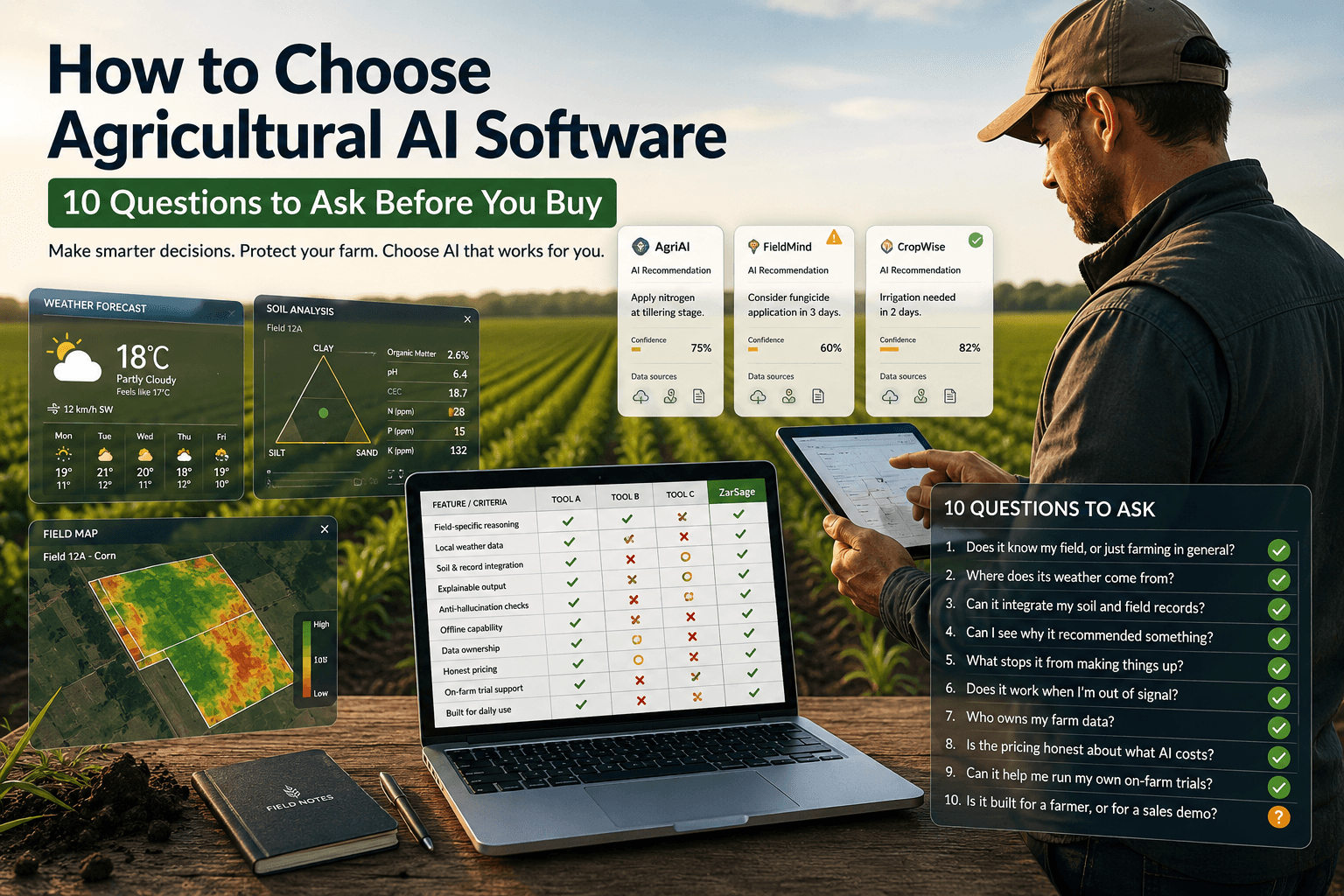
Search “best AI for agriculture” and you get a wall of tools that all promise the same thing: smarter decisions, higher yield, less guesswork. The hard part is not finding an AI tool. It is knowing which one you can actually trust with a decision about your own fields.
A general chatbot can write you a confident paragraph about when to spray. It has no idea what your soil holds, what the forecast looks like over your field this week, or what you planted in that block last season. For a farm, a confident wrong answer is worse than no answer.
This guide gives you 10 questions to ask before you commit to any agricultural AI software. Use them on every tool you are weighing, including ours.
First, the real difference: general AI vs agricultural AI
A general-purpose model is trained to sound right. An agricultural tool has to be right about your specific field, because you are going to act on it. The gap between those two things is where most farm AI quietly fails. It produces advice that reads well and falls apart the moment it meets your actual conditions.
The questions below are designed to expose that gap before it costs you a season.
The 10 questions
1. Does it know my field, or just farming in general?
Generic advice (“apply nitrogen at tillering”) is free everywhere. The value is advice tuned to your soil type, your crop, your growth stage, and your recent history. Ask whether the tool builds a picture of your specific field over time, or starts from zero every conversation.
Good answer: it remembers your fields, crops, and past seasons, and the advice changes when your conditions change.
2. Where does its weather come from, and is it local to my field?
Spray timing, frost risk, and irrigation all hinge on weather that is specific to your location, not a regional average. Ask whether the tool pulls a real forecast for your field coordinates, and whether it can look at historical weather to explain what is happening now.
Good answer: it uses field-level forecast and historical data, and it shows you the numbers it is reasoning from.
3. Can it integrate my soil and field records?
AI is only as good as what it can see. A tool that cannot read your soil data, field boundaries, and crop records is guessing. Ask what data it pulls in and whether you can correct it when it is wrong.
Good answer: soil, boundaries, weather, and your own records all feed the recommendation.
4. Can I see why it recommended something?
This is the most important question on the list. If a tool tells you to act but cannot show its reasoning, you cannot judge whether it is right, and you carry all the risk. Explainable output lets you sanity-check the advice against what you already know about your ground.
Good answer: recommendations cite the evidence they use when sources are available, so you can verify the basis.
5. What stops it from making things up?
Large language models can fabricate a plausible figure, a fake threshold, or a source that does not exist. On a farm, that is not a quirk, it is a liability. Ask what the tool does to catch its own errors before they reach you.
Good answer: the tool verifies factual claims, flags uncertainty, and tells you when it does not know rather than inventing an answer.
6. Does it work when I am out of signal?
Decisions happen in the field, often in the exact spots where connectivity drops. A tool that is useless past the last cell tower is useless when you need it most. Ask what still works offline.
Good answer: your field data and recent advice stay available without a live connection.
7. Who owns my farm data?
Your yield maps, soil tests, and field history are valuable, and not just to you. Before you upload years of records, ask who owns that data, whether it is sold or used to train shared models, and whether you can export and delete it.
Good answer: you own your data, it is not sold, and you can take it with you.
8. Is the pricing honest about what AI actually costs?
AI is expensive to run, so “unlimited AI” is usually either a teaser or hides a throttle. A tool with transparent limits is being straight with you. Ask exactly what you get each month and what happens when you reach it.
Good answer: clear monthly limits, no surprise charges, no hidden API key you have to manage yourself.
9. Can it help me run my own on-farm trials?
The best operators test things on their own ground before betting the farm on them. A tool that can help you set up a comparison, track it, and read the result honestly is worth far more than one that only hands down advice.
Good answer: it supports comparing what you tried against what you would have done otherwise.
10. Is it built for a farmer, or for a sales demo?
Some tools are designed to impress a buyer in a 20-minute call. Others are designed to be used at 6am in the rain. Ask for a trial and use it on a real decision. The difference shows up fast.
Good answer: it earns its place in your routine, not just in the pitch.
A scorecard you can use
| Criteria | Why it matters | Pass / Fail |
|---|---|---|
| Field-specific reasoning | Generic advice does not fit your ground | |
| Local weather data | Spray and frost calls are location-specific | |
| Soil and record integration | AI is only as good as what it can see | |
| Explainable output | You carry the risk, so you must verify | |
| Anti-hallucination checks | A confident wrong answer costs a season | |
| Offline capability | Decisions happen past the last cell tower | |
| Data ownership | Your records are valuable, protect them | |
| Honest pricing | Transparent limits beat hidden throttles | |
| On-farm trial support | Test before you bet the farm | |
| Built for daily use | Demos impress, routines deliver |
Print it. Run every tool you are considering through it.
How ZarSage answers these
We built ZarSage for one person: the owner-operator running their own farm, not a consultant juggling other people’s fields. That focus shapes every answer above.
ZarSage keeps a working picture of each of your fields and updates its analysis as your conditions change. It pulls field-level forecast and historical weather and reads your soil and field records. For supported analyses, it surfaces available sources, assumptions, confidence, and missing evidence so you can review the basis. Your data stays yours. Pricing is plan-based with clear limits, and there is no API key for you to manage.
We are not going to tell you we are the best AI for every farm. We will tell you to run the scorecard. If a tool cannot answer these 10 questions, it is not ready for your fields, whoever built it.
Frequently asked questions
What is the best AI for agriculture? There is no single best one. The right tool is the one that reasons about your specific field, uses local weather and your own records, shows its work, and is honest about its limits. Use the 10 questions above to judge any tool against your farm.
Can I just use ChatGPT or another general chatbot for farming? A general chatbot is useful for explaining concepts and drafting text. It does not know your field, your weather, or your soil, and it can state wrong figures with full confidence. For decisions you will act on, you want a tool grounded in your actual farm data.
What makes agricultural AI different from regular AI? Regular AI is built to produce a fluent answer. Agricultural AI has to be correct about your specific conditions, because you will act on it. That means integrating your soil, weather, and field history, and being able to show why it reached a conclusion.
Does farm AI work without internet? It depends on the tool. Ask specifically what stays available offline, since many of your decisions happen in the field where signal is weakest.